Rethinking repayment communication
@ Health Insurance Company
Health tech · Sole UX researcher · 2023 · 7 business days
To reduce costs from uncovered insurance transactions, the company introduced a feature allowing users to repay outstanding balances through the app. When repayment rates remained low, I interviewed users who had and had not repaid to understand why.
- Approach
- User interview.
- Outcome
- The research revealed that users mistrusted repayment messages and that a bug allowed some users to continue transacting without repaying. A shift to a trusted communication channel and a bug fix were followed by improvements in repayment rates and notification open rates.
- My role
- I led the research design, moderated all user interviews, and synthesized and presented findings. I collaborated closely with product and engineering teams to ensure recommendations aligned with roadmap priorities.
Disclaimers: Certain details have been omitted or generalized to protect confidential company information. Content is optimized for desktop viewing.
Background
Uncovered insurance transactions made through the app created operational costs. To address them, the company introduced a feature allowing users to settle outstanding balances in the app.
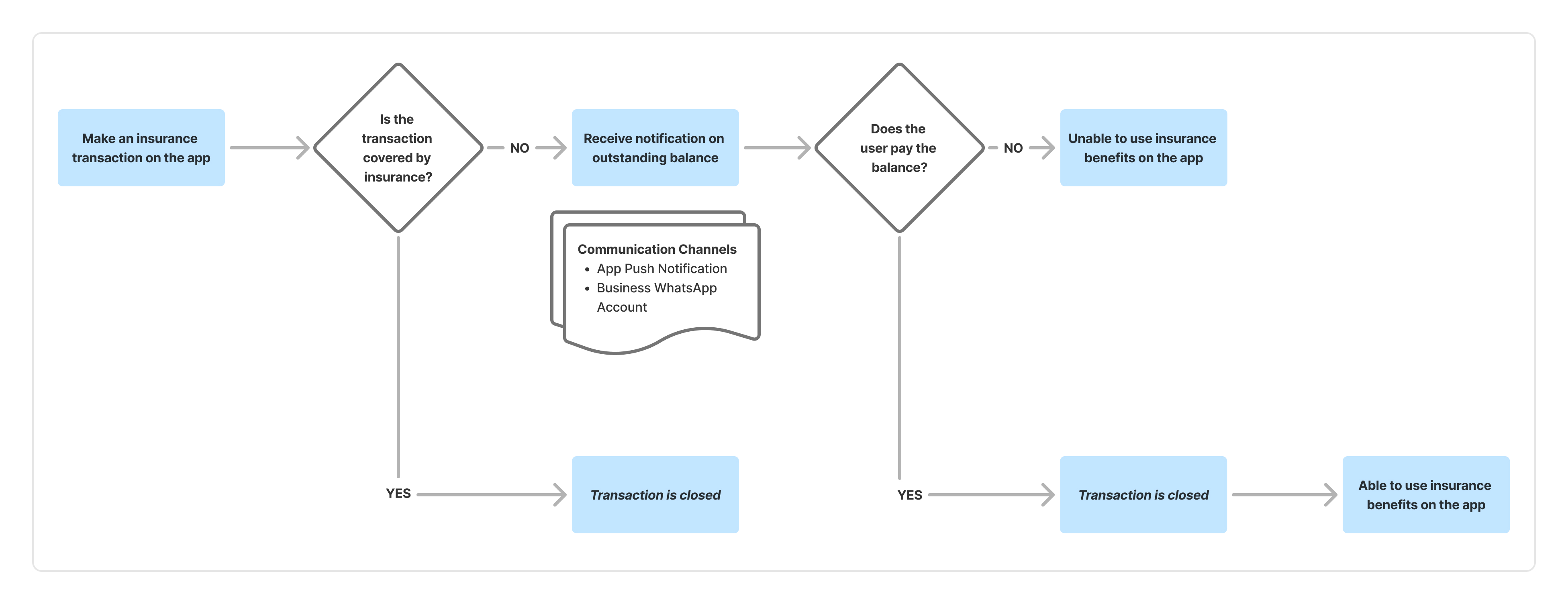
After implementation, repayment rates remained lower than anticipated. I led research into users’ perceptions, behaviors, and friction points to understand what influenced repayment decisions and identify opportunities to improve the experience.
Research questions
- How do users perceive the bill settlement process both within and outside the app?
- Are there specific stages in the journey that lead to confusion or drop-off?
- Why do users choose to settle or postpone payment of their outstanding balance?
- How do experiences and perceptions differ between users who settled their balance and those who did not?
Methods
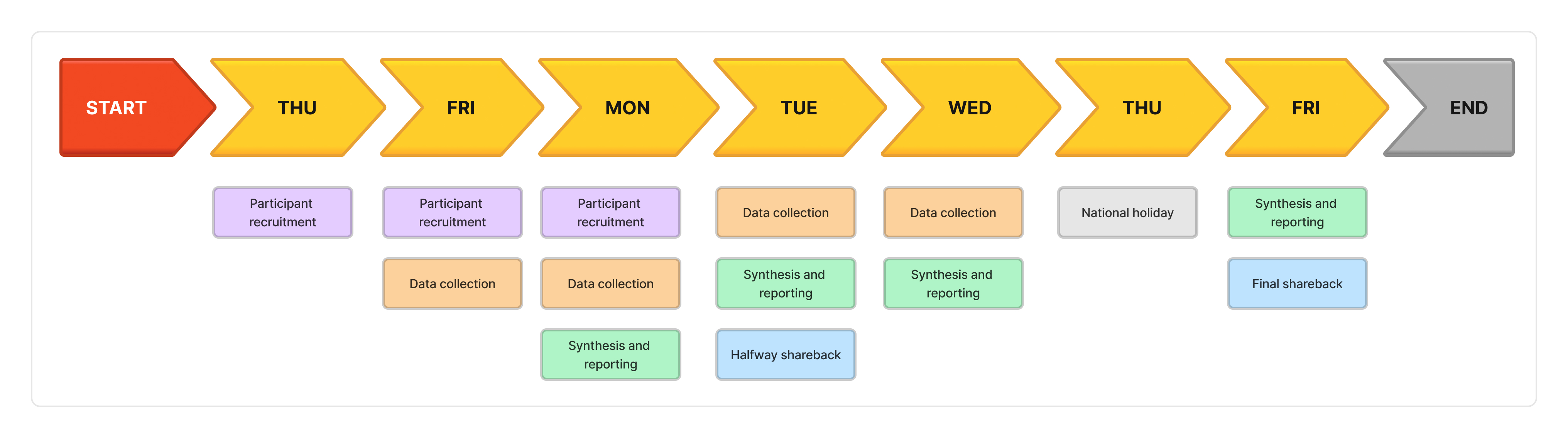
To address the research questions, I conducted 30-minute moderated, semi-structured interviews with 4 end users.
Participants were divided evenly into two groups:
- Those who had successfully settled their outstanding balance
- Those who had not completed the repayment process
Participants met the following criterion:
- Had received a notification regarding an outstanding balance
I used thematic analysis to synthesize the interview findings.
Results and Recommendations
I presented the findings and recommendations in a slide deck to the product manager, product designer, UX writer, and UX writer manager, using interview recordings alongside quotes. We discussed and prioritized the recommendations, and the resulting action steps were communicated to engineering for implementation.
In the weeks that followed, the product manager tracked repayment rates and repayment notification open rates. The metrics were assessed separately and reported together.
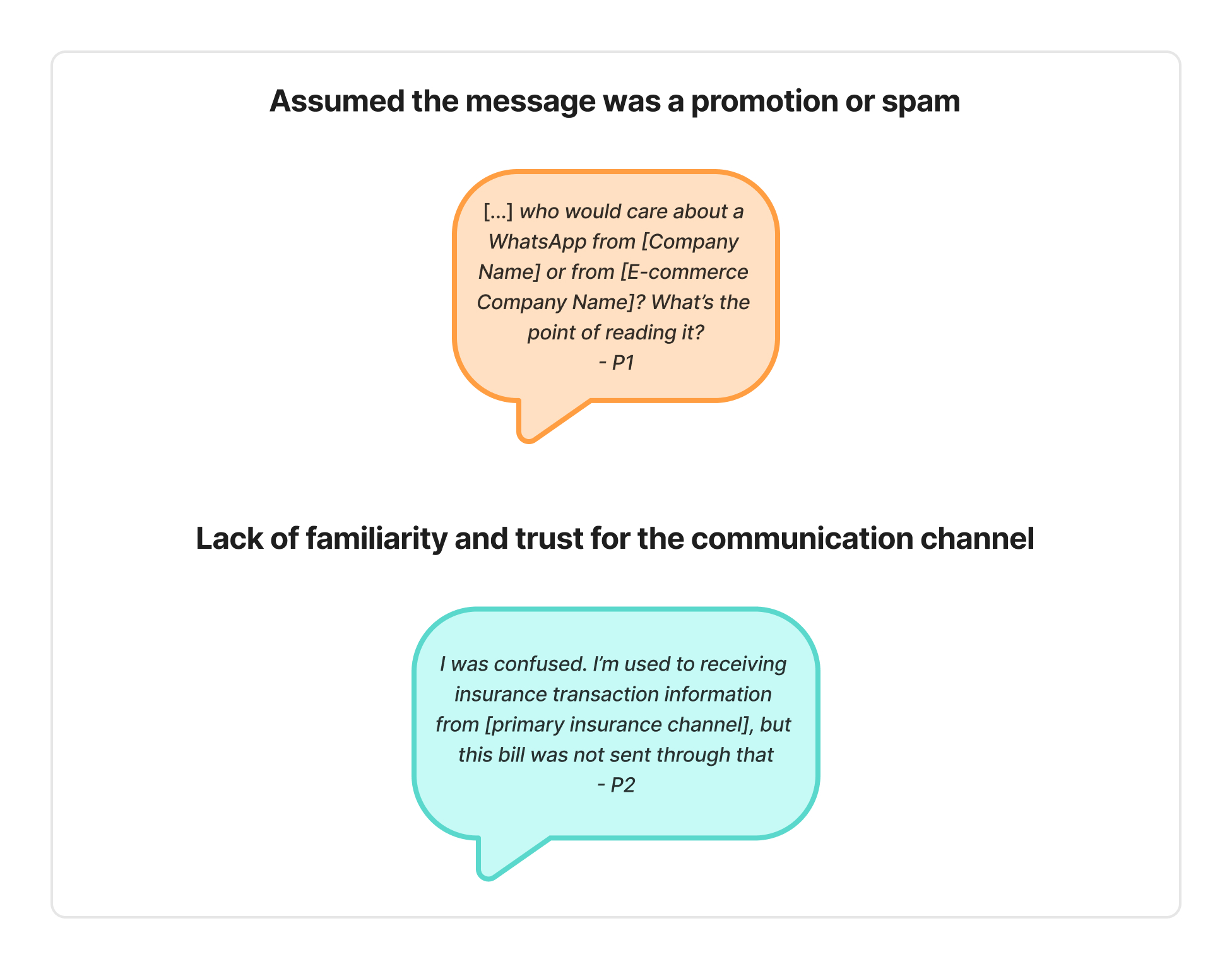
1. Users mistook outstanding balance notifications for spam
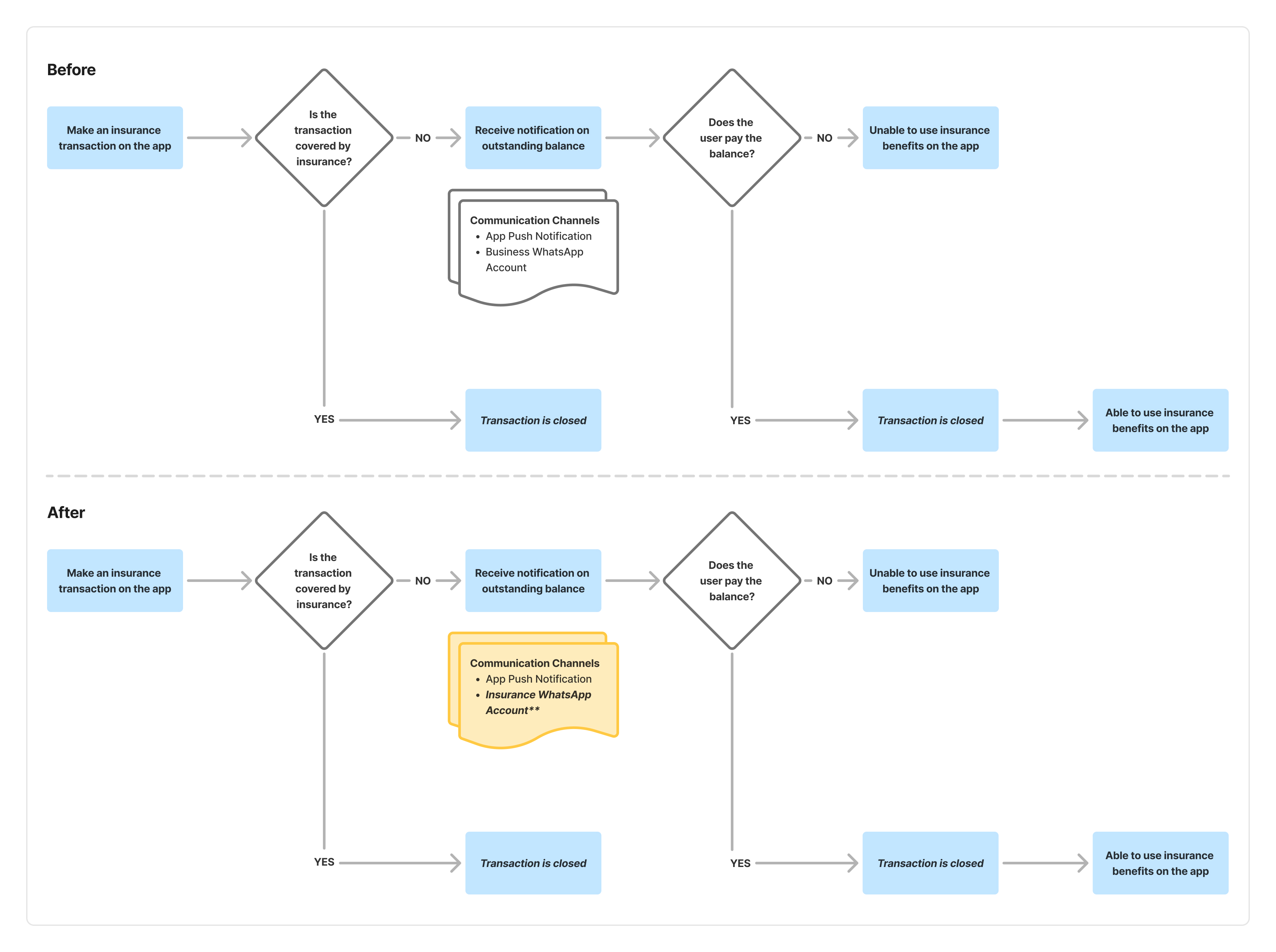
Messages about unpaid balances came from the company’s WhatsApp Business account, which users did not associate with official insurance communications. Some users ignored them, mistaking them for spam or promotional content.
I recommended sending outstanding balance notifications through the primary WhatsApp account users already associated with insurance services, a more familiar and trusted channel.
Impact: After the change, repayment rates and notification open rates improved, suggesting greater responsiveness to the messages.
2. A bug allowed users with outstanding balances to continue transacting
One participant who had not repaid their balance mentioned continuing to use the app’s transactional features. This contradicted the intended flow, which should have restricted access until the balance was cleared.
I flagged the issue to engineering, who confirmed and resolved the bug.
Impact: After the fix, repayment rates increased, and access restrictions aligned with the intended policy.
Reflections
- Handling sensitive topics in user interviews requires care and empathy. Discussing unpaid balances can be uncomfortable, so I paid particular attention to the interview script, my tone, and my responses. I was mindful not to imply that participants had made a mistake or acted irresponsibly. Creating a non-judgmental environment can help reduce bias and encourage candid responses.
- Communication channels must align with user trust and message importance. Choosing a channel involves more than ease of implementation. For messages about payments, service access, or policy enforcement, a familiar and trusted channel can help users recognize the message’s importance and reduce confusion.